

31 Aug Spain UNESCO Cities: 15 World Heritage Sites We Love
Updated August 2026
Ranked in the top five countries worldwide for UNESCO recognition, there are 50 World Heritage Sites in Spain spanning ancient ruins, historic city centres and striking natural landscapes. Steeped in historical significance and natural beauty, they showcase Spain’s rich and diverse cultural legacy.
Among these protected places are 15 Spain UNESCO cities, ranging from Roman centres and medieval strongholds to lively university towns and cities with deep religious significance. Together, they offer a window into Spain’s past and a sense of how history still shapes daily life.
The Magic of Spain UNESCO Cities
UNESCO World Heritage status isn’t granted lightly. This highly prestigious designation is reserved for sites of ‘outstanding universal value’ that meet at least one of ten strict cultural criteria, such as exceptional architecture, masterpieces of human creativity, or unique testimony to past civilisations.
Exploring these historic cities in Spain is like walking through the pages of a living history book. Each offers a unique perspective on the country’s heritage and takes you on an immersive journey through Spain’s multifaceted identity, shaped by Roman, medieval, Renaissance and religious influences.
Here’s our guide to the 15 Spain UNESCO cities, with a brief overview of what makes them stand out and why they deserve a place on your Spain itinerary.

UNESCO World Heritage Cities Spain List
1. Alcalá de Henares
Birthplace of Miguel de Cervantes, renowned author of Don Quixote, Alcalá de Henares earns its place among the World Heritage Sites in Spain thanks to its 16th-century university. The world’s first planned university town, it formed the blueprint for the ‘City of God’ model that Spanish missionaries took to the Americas, and for universities across Europe.
Around 30km east of Madrid, its highlights include Plaza de Cervantes, the Cervantes Birthplace Museum, Spain’s oldest open-air courtyard theatre, and a Renaissance university precinct.
2. Ávila
Known as the ‘City of Saints and Stones’, Ávila is famed for its 11th-century walls, the most complete medieval fortifications in Spain. Stretching for around 2.5 kilometres with more than 80 semicircular watchtowers and nine gates, they turn the old town into a hilltop fortress.
Walk the walls for panoramic views into the old town and over the countryside, or visit after dark to soak up the fairy-tale vibes. Birthplace of Saint Teresa de Ávila, its churches, convents and palaces still draw Catholic pilgrims today.
3. Baeza
Surrounded by a sea of olive groves in Jaén, the small Moorish town of Baeza is home to some of Europe’s best-preserved Renaissance buildings. Its World Heritage status is shared with neighbouring Úbeda (which merits its own entry on our Spain UNESCO cities list), both towns remodelled in the 1600s using the emerging Renaissance style, which later influenced Latin American architecture.
This under-the-radar gem is a peaceful maze of courtyards, churches, palaces and squares, dressed in intricate stone detailing straight out of the Italian Renaissance.
4. Cáceres
One of the prettiest historic cities in Spain, Cáceres has a history of conflict and coexistence, shaped by centuries of battles between Moors and Christians. Its Ciudad Monumental is wrapped in ancient walls and bristling with some 30 medieval towers, including the Torre del Bujaco.
Within its walls, an eclectic mix of Roman, Moorish, Gothic and Renaissance architecture lines cobbled lanes, while turrets, spires, gargoyles and storks’ nests decorate the skyline. With little modern clutter, once the day-trippers have gone it feels like stepping into a ready-made medieval film set.
5. Córdoba
One of the most important cities in Spain, Córdoba has a rich multicultural legacy centred on the magnificent Mezquita-Cathedral, whose forest of columns and red-and-white striped arches earned UNESCO World Heritage status in 1984. Around ten years later, this was extended to the Historic Centre, encompassing monuments such as the Alcázar, Synagogue and Roman bridge.
Magical year-round, Córdoba is resplendent in spring, when the courtyards of the Judería (Jewish Quarter) are blooming with flowers during the Courtyard Festival, itself a World Heritage Event.


6. Cuenca
Perched on a narrow rocky spur between two deep river gorges, the historic walled town of Cuenca owes its World Heritage status to its dramatic setting and remarkable preservation. Built as a Moorish fortress and later a Castilian stronghold, it guarded this clifftop position through centuries of conflict.
Today, it’s a popular weekend escape from Madrid, best explored on foot along steep lanes, medieval walls and castle ruins. Standout sights include Spain’s first Gothic Cathedral and casas colgadas, the ‘hanging houses’ seemingly balanced on the edge of the gorge.
7. Ibiza/Eivissa
Ibiza may be famed for its white-sand beaches and world-renowned clubbing scene, but this Balearic Island is one of only two Spanish UNESCO sites inscribed for both biodiversity and culture.
A diverse marine ecosystem sheltering underwater meadows of Posidonia seagrass, plus the archaeological remains of Sa Caleta and Puig des Molins, contribute to its designation. They’re joined by Dalt Vila, the fortified Upper Town of Eivissa, where cobbled lanes climb to a castle and cathedral, protected by superb Renaissance walls.
8. Mérida
Former capital of the Roman province of Lusitania, Mérida was founded as Augusta Emerita in 25BC. Today, it’s the modern-day capital of Extremadura and home to the most extensive and best-preserved Roman remains in all of Spain.
Scattered around town are the Temple of Diana, amphitheatre, circus, Arch of Trajan, Roman baths, aqueduct, and the superb Museum of Roman Art. Visit in summer to watch a play in the atmospheric Roman Theatre, still hosting performances more than two millennia after it was built.
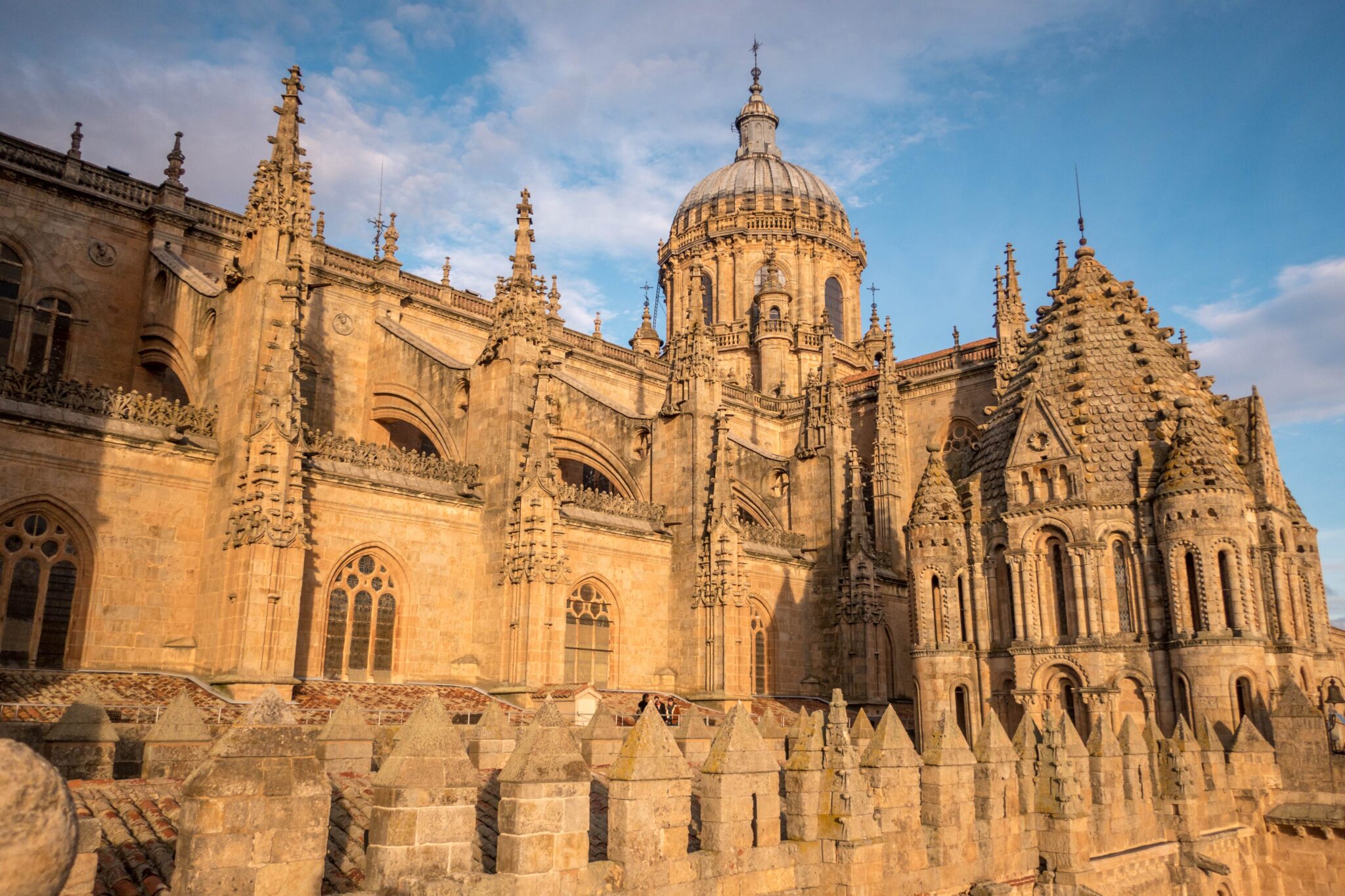
9. Salamanca
One of the most historic cities in Spain, Salamanca rose from Carthaginian, Roman and Moorish roots to become a renowned city of learning. With the founding of its university in 1218, it grew into one of Europe’s most prestigious centres of scholarship, ushering in a long golden age.
Its old town blends Romanesque, Gothic, Moorish, Renaissance and Baroque monuments around the impressive Plaza Mayor. Almost everything is constructed from honey-coloured sandstone that glows in the late-afternoon sun, earning Salamanca its enduring nickname, ‘the Golden City’.
10. San Cristóbal de la Laguna
Located on Tenerife, largest of Spain’s Canary Isles, San Cristóbal de la Laguna is a graceful colonial town of pastel-hued mansions, elegant churches, and wooden balconies edging hidden courtyards. Known simply as La Laguna, it was the first non-fortified Spanish colonial town, its design paving the way for a new style of town planning.
Arranged in a grid-style layout radiating from a central square, La Laguna’s streets and plazas have been replicated across the Americas, from Quito and Lima to Old Havana and Cartagena.


11. Santiago de Compostela
Easily one of the most beautiful World Heritage Sites in Spain, Santiago de Compostela is one of Christianity’s great holy cities and the historic destination of the Camino de Santiago. Begun in the 11th century, its magnificent cathedral is a masterpiece of Romanesque, Gothic and Baroque elements, home to the tomb of St James and the celebrated Portico de la Gloria.
Outside, the Praza do Obradoiro is where weary, jubilant pilgrims finally lay down their packs, while the sense of history and spiritual energy flows throughout the city’s vibrant streets.
12. Segovia
Against the backdrop of the Sierra de Guadarrama, Segovia’s UNESCO-listed old town is dominated by a soaring Roman aqueduct, built around the 1st century AD and still standing without a drop of mortar. Its twin tiers of granite arches stride straight through the city, a monumental testament to Roman engineering.
Elsewhere, Segovia’s honey-coloured streets lead to the clifftop Alcázar, a fairy-tale fortress said to have inspired Disney’s castle, and to the vast Gothic cathedral, the last of its kind built in Spain.
13. Tarragona
On Catalonia’s Costa Daurada, Tarragona combines Mediterranean beaches with some of Spain’s finest Roman ruins. Once the provincial capital of Tarraco, it was the first Roman settlement on the Iberian Peninsula, and a major administrative and mercantile hub.
The UNESCO-listed archaeological ensemble includes city walls, forums, an aqueduct and a mosaic-filled museum. It’s also home to one of Western Europe’s best-preserved Roman circuses and a seaside amphitheatre set against the sparkling Mediterranean.
14. Toledo
Toledo is one of Spain’s most intriguing cities. A former capital with over 2,000 years of history, it bears the imprint of Roman, Visigothic, Islamic and Christian rulers. But it’s most notable for the religious tolerance that earned it the nickname, ‘City of Three Cultures’.
A Gothic cathedral, 10th century mosque and two synagogues coexist within a few metres, where Christian, Muslim and Jewish communities once lived side by side. The Alcázar fortress and legacy of El Greco paintings complete the city’s unique cultural tapestry.
15. Úbeda
Úbeda shares its World Heritage status with Baeza, twin towns transformed in the 16th century under the influence of Italian Renaissance architecture. The larger of the two, Úbeda showcases Renaissance town planning in its orderly streets and fine Italianate stone detailing.
Start at Plaza Vázquez de Molina, one of Europe’s most beautiful squares, then wander between churches, chapels, palaces and the former Hospital de Santiago. Don’t leave without sampling local specialities enriched by the region’s ‘liquid gold’ – Jaén’s celebrated olive oil.


Explore World Heritage Sites in Spain with Just Explore
If these Spain UNESCO cities have sparked your wanderlust, Just Explore can turn them into a tailor-made itinerary that’s uniquely yours. From World Heritage Sites in Spain to off-the-beaten-path gems, our customised tours balance culture, food and authentic regional immersion. Tell us what you love, and we’ll craft your own route through Spain’s most historic cities.
Spain UNESCO Cities: Cities we love by GrupoCPHE (Group of the World Heritage Cities in Spain)